Seoul Never Sleeps: A Look at Korea’s Late-Night Café Culture

Discover why Seoul’s cafés stay open late into the night through my experience as a foreigner in Korea: coffee culture, nightlife, students, and the unique atmosphere of Korean cafés.
Hi everyone ! ✨
This is Eva Glanger, the French student studying international business in Paris.
Welcome to my third blog post about life in Korea!
Since you’re starting to get to know me a little, you probably already know how much I love discovering the little everyday habits in Seoul.
In this blog, I’ll share what I’ve noticed while living in Seoul, why cafés play such an important role in Korean life, and what makes them, in my opinion, so different from the ones we know in France.

My first impression
When I first arrived in Seoul, I was surprised to see how different the café culture was.
In France, I was used to small neighborhood cafés, lively outdoor seating in the late afternoon, and long chats with friends. For me, it was mainly a place to take a break during the day.
But in Korea, I quickly realized that café play a very different role in society.
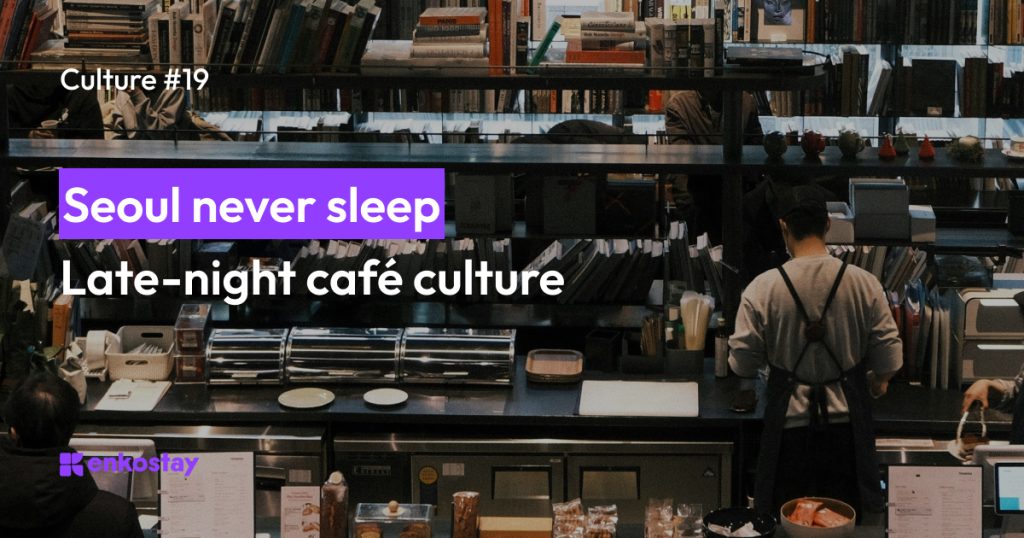
What struck me at first was the impressive number of cafés on the streets of Seoul, but especially the fact that they stay open very late. During my first few weeks here, I still saw cafés packed at 10 p.m., sometimes even at midnight.
I wondered: Who drinks coffee that late? Why do so many people spend hours in front of their computers?
Little by little, I realized that Korean cafés aren’t just for drinking coffee. They’re true living spaces: places where people work, study, relax, or simply spend time alone.
Today, I think I can say that it perfectly represent modern Korean culture.
I’m staying near Hongdae, a neighborhood known for its nightlife and bustling streets. One evening, after dinner, I went out for a walk around 11 p.m. In France, at that hour, most cafés and restaurants would already be closed.
But to my surprise, the city still seemed wide awake.
The restaurants were full, the convenience stores were lit up, the streets were busy, and above all, the cafes were full of people.
Through the windows, I could see students surrounded by books, people sitting alone with their headphones on, and employees working on their laptops.
What struck me most was the calm. Even late at night, the cafés maintained an almost silent atmosphere, with only the sound of keyboards and soft music in the background.
Cafés in Seoul serve more than just coffee
That’s probably the first thing I learned while living in Korea.
In France, even though going to cafés for work is fairly common, they’re mainly associated with relaxation or chatting with friends. In Seoul, they serve a much broader purpose.
Cafés often function as:
- temporary offices
- study rooms
- rest areas
- meeting spots
- places to spend time alone
Some people stay there for hours.
At first, this surprised me a lot. Then I eventually realized that cafés are designed for this purpose: comfortable seating, free Wi-Fi, electrical outlets, and a calm atmosphere.
Little by little, I, too, began to adopt this habit…
The rhythm of Korean life explains a lot
The lifestyle in Seoul also explains why cafés stay open so late.
Students work hard, employees often finish late, and the city remains very lively even after 10 p.m. Cafés therefore become convenient places to work, study, or simply spend time away from home.
Since living spaces are sometimes small, many people also use cafés as a more comfortable place to relax.
The Culture of Work and Study
The importance placed on work and study in Korea made a huge impression on me.
At any time of day, cafés are filled with students working on their assignments or on their computers. Some places almost look more like libraries than cafés.
Large tables, outlets everywhere, a quiet atmosphere… everything is designed to let you work for hours on end.
The Aesthetics of Korean Cafés
Korean cafés are also very popular for their aesthetics. In Seoul, every café has a different vibe: minimalist, vintage, modern, or inspired by K-dramas. In neighborhoods like Seongsu or Ikseon-dong, some almost look like art galleries.
Sometimes I go there just to check out the decor and atmosphere.
Talking about coffee shops might seem like a very simple topic. But living in Seoul, I’ve come to realize that behind the opening hours and atmosphere of these places lie differences in lifestyle, pace, and even culture between countries.
Korean cafés show just how fast-paced, active, and focused on work or studies life in Seoul is, even late at night. And I find it fascinating to see how a simple café can ultimately say so much about a country.
Thank you for your interest !
Best regards,
Eva Glanger